

Ingress Protection (IP) Rating Test
The Ingress Protection (IP) Rating Test is used to evaluate the ability of an enclosure to protect equipment from external substances such as dust and moisture.
This test is designed to determine the capability of a device to function normally under various environmental conditions, particularly when exposed to dust and water. It is widely applied in electronic devices, electrical enclosures, lighting equipment, and other products to ensure their reliability and durability in specific use environments.
Composition of IP Ratings
IP ratings consist of two digits, where the first digit represents the level of protection against solid objects (e.g., dust), and the second digit represents the level of protection against liquids (e.g., water).
l First digit (0-6): Indicates the level of protection against solid particles such as dust.
l Second digit (0-9): Indicates the level of protection against liquids such as water.
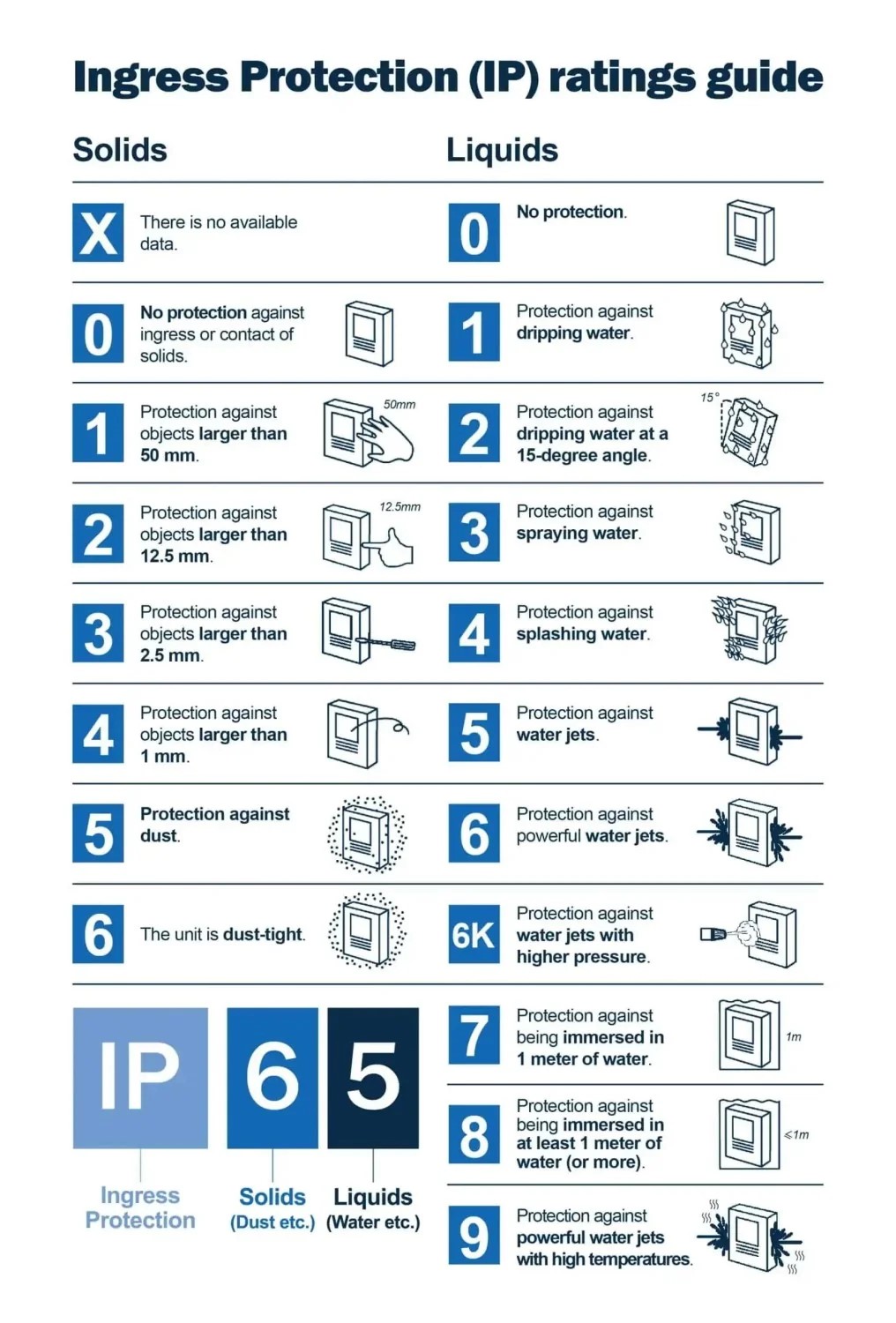
Solid Particle Protection (First Digit)
|
Digit |
Protection Description |
|
0 |
No protection |
|
1 |
Protection against solid objects larger than 50 mm (e.g., back of the hand) |
|
2 |
Protection against solid objects larger than 12.5 mm (e.g., fingers) |
|
3 |
Protection against solid objects larger than 2.5 mm (e.g., tools, thick wires) |
|
4 |
Protection against solid objects larger than 1.0 mm (e.g., most wires) |
|
5 |
Dust protection (limited ingress of dust permitted, but not enough to interfere with operation) |
|
6 |
Fully dust-tight (no ingress of dust) |
Liquid Protection (Second Digit)
|
Digit |
Protection Description |
|
0 |
No protection |
|
1 |
Protection against vertically falling water drops |
|
2 |
Protection against water drops when the device is tilted up to 15° |
|
3 |
Protection against spraying water (up to 60° from vertical) |
|
4 |
Protection against splashing water from any direction |
|
5 |
Protection against low-pressure water jets from any direction |
|
6 |
Protection against powerful water jets from any direction |
|
7 |
Protection against immersion in water up to 1 meter for 30 minutes |
|
8 |
Protection against prolonged immersion under conditions specified by the manufacturer |
|
9K |
Protection against high-pressure, high-temperature water jets |
Specific Testing Processes for IP Rating
1. Dust Protection Test:
l A specialized dust chamber is used to generate a specified amount of dust, in which the device is placed.
l The test duration and conditions are set according to the product's required protection level. For high protection levels (e.g., IP6X), the device must be exposed in a sealed dust environment for a specific time, ensuring no dust ingress.
Water Protection Test:
l Water protection tests use various water sources, such as water spray devices, water flow setups, or even direct immersion of the device in water.
l Test conditions include water pressure, temperature, spray angle, and duration, depending on the required protection level. For example, an IPX7 test requires the device to be submerged in 1 meter of water for 30 minutes, while an IPX9K test requires it to be subjected to high-pressure, high-temperature water jets.
Evaluation and Results:
l After testing, the device is evaluated to determine whether dust or water has entered the enclosure. This evaluation is done through visual inspection, electrical performance testing, or other methods to ensure the device's functionality and integrity are maintained.
l Based on the test results, the device is assigned the appropriate IP rating.
Application Areas
l Consumer Electronics: Devices like smartphones and smartwatches typically have some level of water and dust protection, commonly rated IP67 or IP68.
l Industrial Equipment: Control cabinets, sensors, and switchgear, which often need to operate in harsh environments, typically require higher IP ratings.
l Lighting Equipment: Especially outdoor lighting fixtures, which need to have high levels of water protection, such as IP65 or higher.
IP rating tests help manufacturers ensure their products are safe and durable in their intended environments, and they also serve as an important reference for consumers when selecting equipment.