

Why is it necessary?
Electrical issues in appliances can lead to fire hazards or the risk of electric shock.
Without proper testing and maintenance, even appliances like refrigerators or dishwashers can be dangerous.
Types of Appliance Testing
Appliance testing can be divided into two main categories: hot testing and cold testing.
Hot testing: Tests conducted while the device is powered on.
Cold testing: Tests conducted while the device is unplugged.
Steps of Appliance Testing
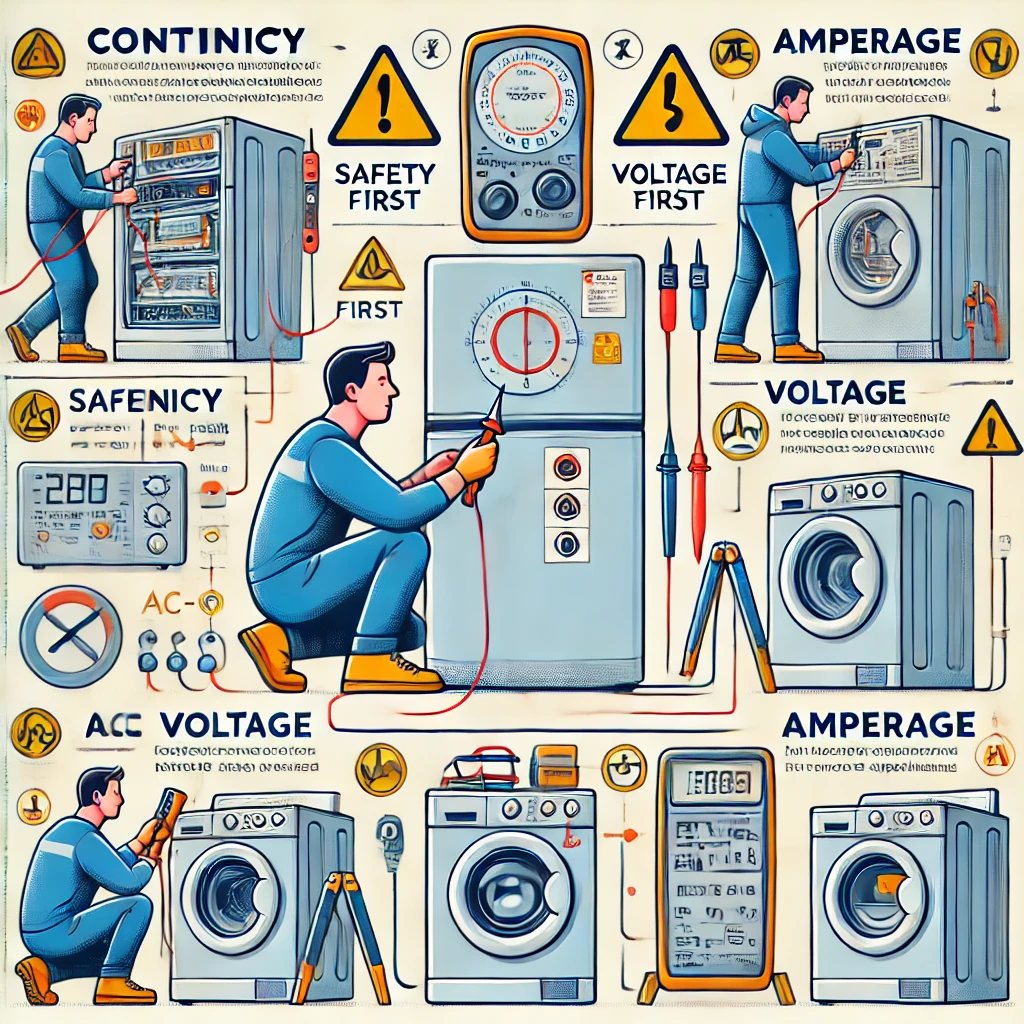
During electrical testing of appliances, professionals typically measure three different electrical parameters: continuity, voltage, and current.
Safety First:
Avoid touching any electrical components with your skin, don't touch the metal tips of the multimeter leads, and don't allow the multimeter leads to touch each other. Electrical testing is the work of experienced professionals.
1.Continuity
1. First, unplug the appliance and disconnect it from any water or gas pipes.
2. Set the multimeter to the "ohm" function.
3. Now, test the electrical continuity of switches, thermostats, and other contacts that should be closed. To do this, touch one end of the multimeter lead to the terminal (the contact point of the component) and the other end to the opposite contact point.
4. If the closed contacts have good conductivity, the reading should be 2 ohms or less. If the reading is higher than 2 ohms, the electrical controller you are testing may need to be replaced.
5. For components other than those mentioned above, the resistance should vary. Refer to the manufacturer's manual to ensure you are looking for the correct ohm reading.
2.Voltage
1. After confirming that the outlet voltage is safe, you can proceed with these steps.
2. First, ensure the appliance is turned off and plugged in.
3. To check if voltage is flowing "downstream" from the outlet into the appliance, set the multimeter to the AC voltage setting.
4. Turn off the appliance, and then touch the circuit with the multimeter probes to read the voltage.
5. The target voltage depends on the type of appliance you have and the component you are testing.
6. When testing the voltage of a dryer heating element, stove, or furnace element, look for 240V AC.
7. When testing the control voltage on 120V appliances for solenoids, timers, and other components, look for 120V AC.
8. If the voltage reading is below normal, one of the following issues might be present:
Circuit problem: Typically a switch or thermostat is open or has poor conductivity.
Poor wire connection: Check if wires are burned or discolored.
3.Amperage
Testing amperage or current is another way to check continuity.
The main difference is that amperage testing is done while the appliance is plugged in.
1. Set the multimeter to the "amp" range (A), not the "milliamp" range.
2. Turn off the appliance and connect the multimeter to the circuit to be tested.
3. Turn the appliance back on and get a reading from the multimeter.
4. Refer to your appliance manual to see if the detected amperage matches the operating load of your device.
5. If the amperage reading is lower than it should be, a component may have failed, causing excessive resistance. If the amperage is too high, a component may have failed, causing a short circuit and lowering the resistance.
Modern Appliances are Complex
Most modern appliances have both AC and DC circuits.
l AC circuits power high-load components like motors, heaters, and compressors.
l DC circuits are used to control AC circuits. For example, there may be 12V DC and 5V DC circuits powering computers and precision electronics. Computers use low-current wires to monitor high-current AC components and turn them on and off as needed.
Therefore, when conducting appliance testing, it can be difficult to know where to start because so many components are interconnected.